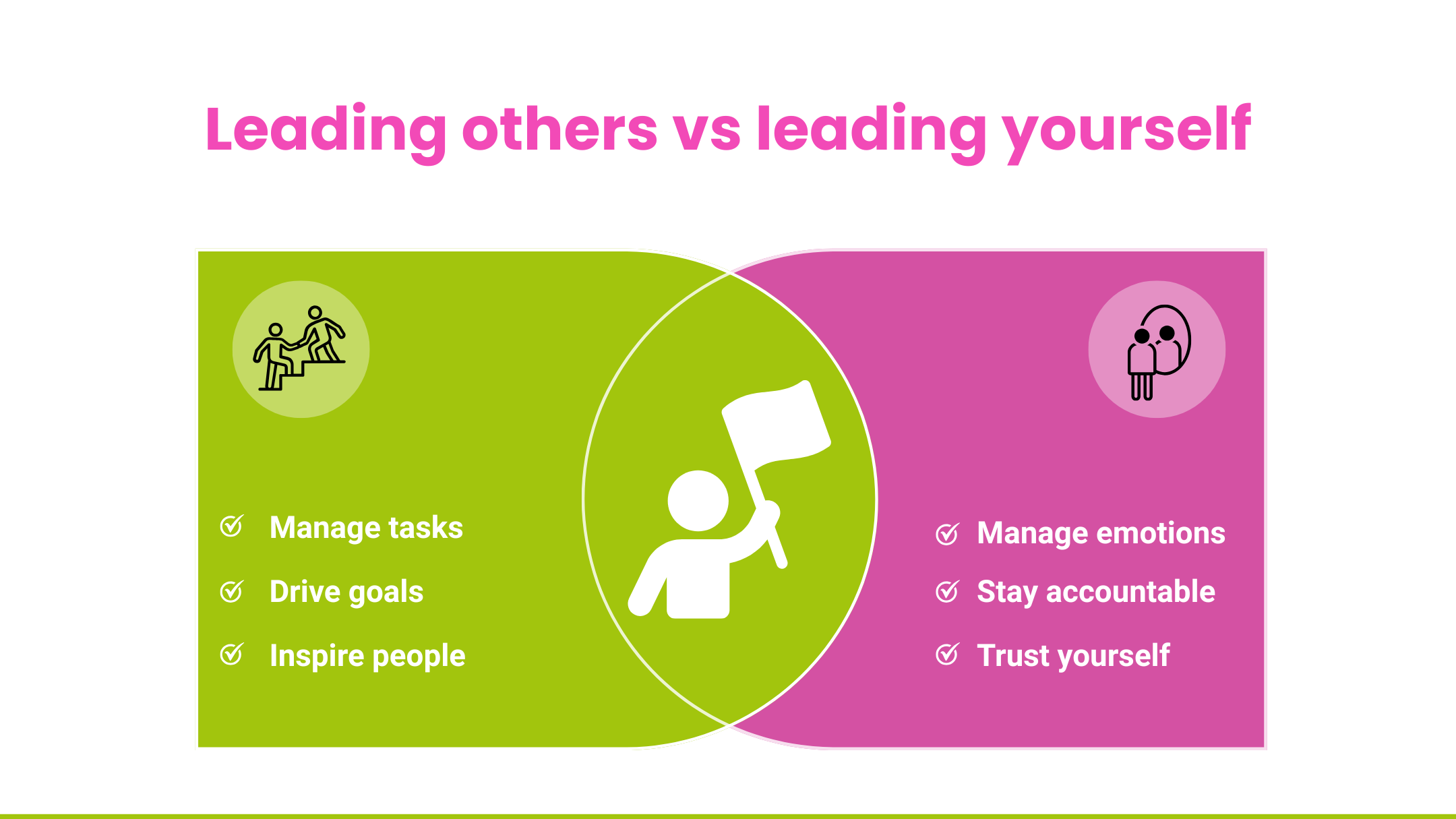
We often talk about leadership as if it’s only about others inspiring teams, driving results, influencing change. But the truth is, before you can lead anyone else, you must first learn to lead yourself. And that’s where it gets uncomfortable.
Because self-leadership isn’t about titles, systems, or strategy it’s about truth. It asks you to face the mirror and take responsibility for everything that happens in your life, even the parts that feel out of your control.
Why is it so hard to lead ourselves?
Because leading ourselves demands a level of honesty that no external leader can impose. It means calling yourself out when you abandon your own vision, when you betray your promises, or when you quiet your truth to please others. Most people can manage others long before they can manage their own emotions, impulses, and fears.
- It’s easier to give feedback than to sit in self-reflection.
- It’s easier to motivate a team than to rekindle your own faith after failure.
- It’s far easier to demand consistency from others than to hold yourself accountable when no one’s watching.
That’s why self-leadership is not for the faint-hearted.
What true self-leadership looks like?
It’s having a compelling vision not just for your work, but for your life.
It’s taking full ownership of both rise and fall.
It’s having faith in your abilities when self-doubt tries to take over.
It’s showing up with vulnerability when being visible feels terrifying.
It’s anchoring yourself in chaos and uncertainty while still moving forward in alignment.

True self-leadership asks:
- Can you hold space for others when you’re still figuring out your own next step?
- Can you stay calm when plans collapse?
- Can you keep showing up when there’s no applause?
The story of a lawyer who found herself again
One of my clients, a successful lawyer working with global corporations, once told me,
“I’ve hit every target, but I don’t feel anything.”
Her days were filled with big negotiations, international deals, and accolades that looked impressive on paper. But inside, she felt small. When she brought in the largest deal in her firm’s history, she expected joy. What she felt instead was emptiness, the kind that no bonus could fill.
Eventually, she walked away. She bought a farmhouse in the countryside, searching for silence and space. But peace didn’t come easily. She wrestled with guilt, was she giving up? Was she wrong for wanting both abundance and alignment?
Her turning point came when she realized she didn’t have to choose between success and soul. She could redefine success on her own terms where wealth and purpose could coexist. That’s when she stopped chasing expectations and started leading herself.
Her life at work flourished again not because she worked harder, but because she worked truer.

What happens when you lead yourself?
Self-leadership changes everything. Working on the lines of the ACE module, can change the paradigm for you: Authenticity, Clarity, and Energy.

- It roots you in your center: Instead of spinning around others’ opinions, you begin to make choices from truth, not from fear or validation.
- It makes you resilient: You stop collapsing when things don’t go your way because your worth is no longer pinned on outcomes. You rise, you learn, and you keep walking.
- It turns productivity into presence: You stop pushing through burnout and start creating from flow. You understand your energy, you respect its rhythm, and you lead in sync with it.
- It amplifies your impact: People feel congruence before they understand it. When your actions, words, and energy align, your presence becomes magnetic.
- It sets you free: You stop measuring success by wins and losses. You live by alignment where what you do, think, and feel are all dancing in rhythm with who you truly are.

My own lesson in self-leadership
Years ago, during my corporate career, I presented a business report that showed negative growth in my division. I believed honesty was the foundation for change. But before I could even finish explaining, I was shut down accused of being careless and uncommitted.
The easy thing would’ve been to shrink. Instead, I went back, gathered data, spoke to every department, and proved my analysis was sound. Eventually, my voice was heard. That experience taught me a vital lesson: I didn’t just need to perform well, I needed a corporate environment where truth was welcome.
That’s what self-leadership does: it helps you choose from clarity, not fear. It turns judgment into discernment and setbacks into redirection.
“Self-leadership is the art of choosing truth over comfort.” — Shuang-Min Chang
So, why is self-leadership hard?
- Because it asks you to hold yourself to a higher standard than the world demands.
- Because it means walking in truth when imitation is easier.
- Because it questions not only what you do, but who you’re being while you do it.*
And yet that’s exactly why it matters.
Without self-leadership, success becomes a chase. You hit milestones but miss meaning. With self-leadership, success becomes a journey one that nourishes instead of drains, connects instead of isolates, fulfills instead of performs.
Self-leadership isn’t about control. It’s about devotion to your vision, your truth, and your unique rhythm of creating impact. Because in the end, leading yourself isn’t just where leadership begins, it’s where true success finally feels like home.
Let’s continue the dialogue:
- What does self-leadership mean to you when no one is watching?
- Where do you notice yourself leading others but not yourself?
- What fears arise when you follow your truth instead of expectations?
- How would your life shift if you led from your inner wisdom instead of external validation?
Self-leadership isn’t about control, it’s about devotion to your truth, your vision, and your unique way of creating impact.
– Authored by @Shuang-Min Chang