The discussion of courage versus fear has been going on for centuries. In every leadership seminar, in every motivational book, the theme repeats: fear holds you back, courage pushes you forward. But for high-achievers, the lived reality feels far more complicated.
The human mind is wired for safety. It clings to what’s familiar because the familiar feels survivable. That’s why we call it the “comfort zone.” But for ambitious leaders, visionaries, and professionals, this comfort often hides a quiet discomfort: the nagging sense of stagnation, the resistance to change, the fear that one mistake could undo years of effort.
Fear, in this sense, isn’t just an emotion. It’s a strategy the mind uses to protect us. The problem is, in a world that changes faster than ever before, this protection can become a prison.
When fear walks into the boardroom?
In my last corporate career, I worked in China, a market that changed with breathtaking speed and played entirely by its own rules. For the luxury industry, this wasn’t just another territory; it was the heartbeat of global growth.
Chinese customers were among the most demanding in the world. They expected both cutting-edge technology and the most refined human connection. For global luxury companies, this market wasn’t optional, it was essential. And yet, it was incredibly hard to please.
Every year, we were handed impossible sales targets. Every year, we had to reinvent strategies, events, training, and processes to keep pace with new technologies and rapidly shifting customer preferences. Each season, our boss asked us to bring something bold and unfamiliar to the table. And every time, the pattern repeated:
- First came the fear: Whispers behind closed doors, complaints in hallways, doubts voiced in the boardroom.
- Then came the commitment: Once the storm of resistance passed, we pulled together as a team.
- Finally came the courage in action: Ideas tested, risks taken, solutions created, goals met.
Fear was never absent. It lived in every debate and every sleepless night before a launch. But courage was what carried us through. It was the deeper comfort that allowed us to act in uncertainty, trust one another, and adapt quickly enough to thrive in a market that never stopped moving.
That experience shaped my understanding forever: courage is not the opposite of fear; it’s the anchor that lets us move with fear.

The real battle isn’t fear vs courage
In the personal development world, we often hear the mantra: “Step out of your comfort zone.” The image it paints is dramatic as if growth requires dragging yourself painfully into unknown territory.
But what if the framing itself is flawed?
Fear and courage aren’t enemies locked in an endless battle. And comfort isn’t something we abandon once and for all. Instead, courage expands what comfort means. It teaches us to feel at home even when the ground is shifting.
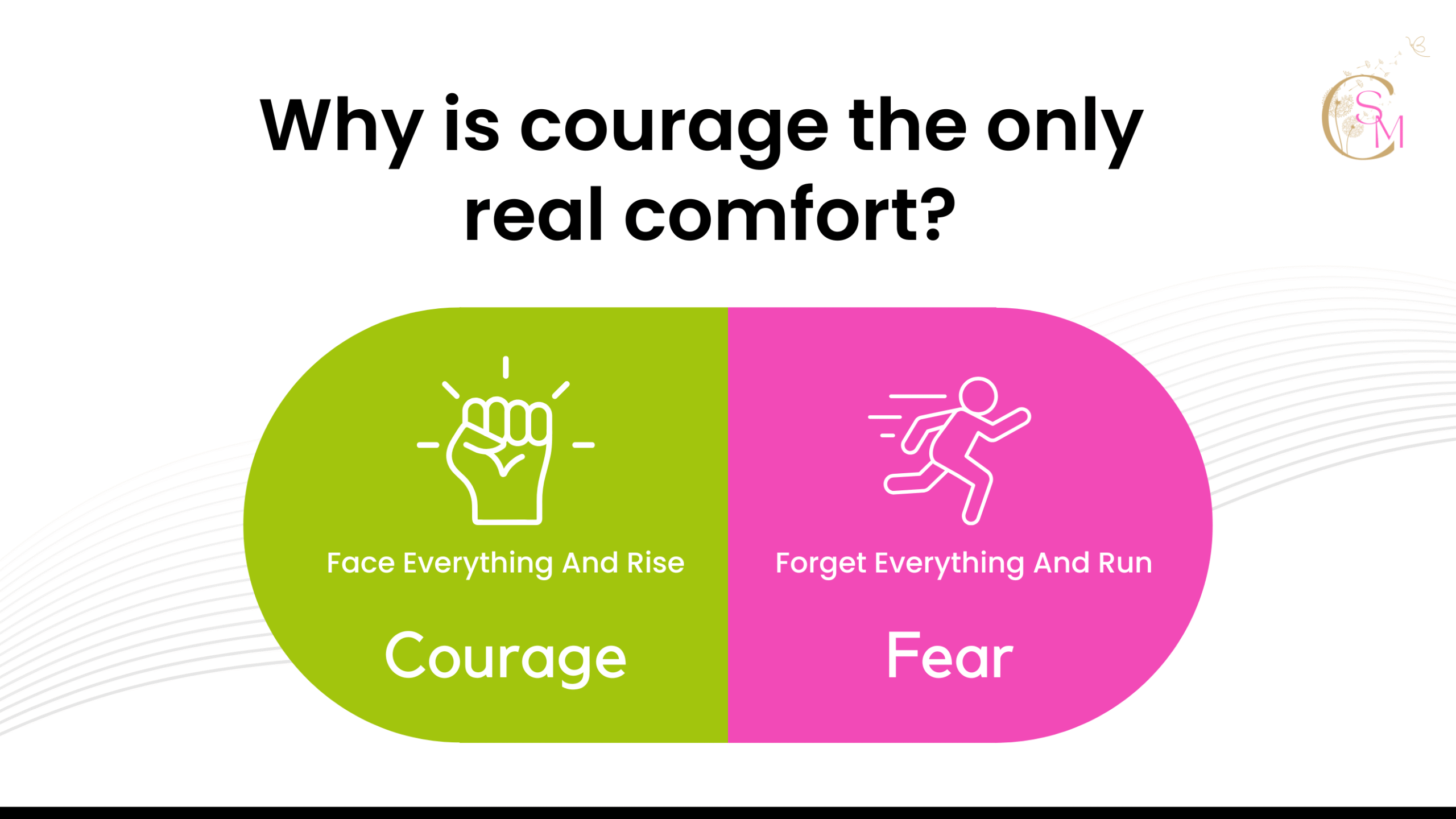
Fear says: “This is new, stay away.”
Courage says: “This is new, but you can trust yourself here.”
When we begin to see it this way, courage stops being an occasional act of bravery. It becomes a deeper, steadier comfort, the kind that makes change livable, even energizing.

Change is not the exception, it’s the rule
We live in an era of constant movement. Technology disrupts industries overnight. Markets pivot with dizzying speed. Careers reinvent themselves more than once in a lifetime. What felt secure yesterday may vanish tomorrow.
To fight change is to fight reality itself. That battle will always leave us exhausted.
Here’s the radical reframe: change is not the enemy. Change is our true nature.
Every cell in our body regenerates. Every season in nature carries cycles of birth, growth, and release. Every challenge we face in life shapes us into someone new.
When we accept this, courage stops being about “leaving the comfort zone.” Instead, it becomes the only comfort we can truly rely on the trust that no matter what changes, we will find a way to meet it.
What courage really offers?
Courage doesn’t erase fear. It doesn’t guarantee smooth paths or perfect outcomes. But it transforms our relationship with the unknown. With courage:
- Uncertainty feels less like a threat and more like an invitation.
- Failure feels less like a verdict and more like feedback.
- Leadership feels less like carrying the weight of the world and more like walking alongside others in trust.
For high-achievers, this shift is life-changing. Instead of burning energy resisting change, they begin to flow with it. Instead of being paralyzed by fear, they act with clarity. Instead of chasing control, they discover presence.
An invitation to reflect
So, let me ask you: Where in your life are you mistaking fear for safety? And what would shift if you let courage, not comfort, be your anchor?
The world will not stop changing. Fear will always whisper in moments of uncertainty. But courage can be your truest comfort, your most reliable guide, and your deepest strength.

Let’s continue the dialogue!
- What does courage mean to you in moments of change?
- Have you noticed how fear shows up when you’re asked to step into the unfamiliar?
- Where in your work or life have you mistaken fear for safety?
- What would shift if you trusted courage as your real comfort?
Share your reflections in the comments. Let’s open this conversation because courage isn’t about fighting fear, it’s about finding steady ground within change. And in today’s world, change is the only constant.
– Authored by @Shuang-Min Chang